Suicide note
Here There Is No WhyA suicide note in the novel is both a missing piece of evidence and an inadequate promise of explanation. Chaim Lerner leaves no note, a silence that feeds competing accounts of his death; Mary Loeb leaves a short letter addressed to Judah and Hannah, but Hannah withholds it for twenty-seven years. When the letter finally surfaces, its statements of apology and reassurance do not resolve the family’s questions. The contrast turns the note from a simple message into a measure of what words can—and cannot—make knowable about suicide.
Absence and the account of Chaim’s death
Chaim’s lack of a note becomes part of the case for doubting that he killed himself. The narrator recalls other details that complicate the accepted explanation: Chaim had been planning a film and a new book about Zionism, bought two tickets to Italy for a promised holiday with his wife, and prepared a syllabus and lecture notes for a new class at Hebrew University. People who knew him described him as joyful and loving; one recurring judgment was that he was “The last person you would expect to commit suicide.” The absence of a note sits alongside these life-affirming details, though none of them alone settles what happened.
The narrator also weighs Chaim’s writing against the possibility of suicide. In “Moments of Reprieve,” Chaim gives a stolen apple slice the force of a miracle: its sweetness and juice briefly ease hunger and thirst. Elsewhere, he recalls the ethics of stealing in Auschwitz, where taking food could mean survival but refusing to give anything back was a sin. These memories present a man able to find moments of beauty and a wry ethical life amid horror. They make suicide seem difficult to reconcile with his outlook, but they do not prove that it was impossible.
The question becomes explicit in an interview conducted on Chaim’s balcony less than a month before his fall. Asked about Holocaust writers who took their own lives, Chaim notes that these writers had left no suicide notes, despite their literary skill. He raises the possibility that their work itself might be their note, then resists treating that possibility as a settled answer. His questions—“Why no note? Why? Sometimes, there is no why.”—make the absence meaningful without turning it into a decipherable message. In this account, silence is not evidence that nothing can be said; it is a limit on what the living can confidently claim to know.
Mary’s letter and Hannah’s silence
Mary’s note is not found with her body by Judah. Years later, while traveling with his adult daughter Hannah, Judah tries to console her about the absence of a note from her mother. He reminds her that she was five when Mary died and would not have been able to read one. Hannah acknowledges this, but the conversation reveals only that she has not told him what she knows. She has carried the letter with her, intending to show it to him for roughly twenty years.
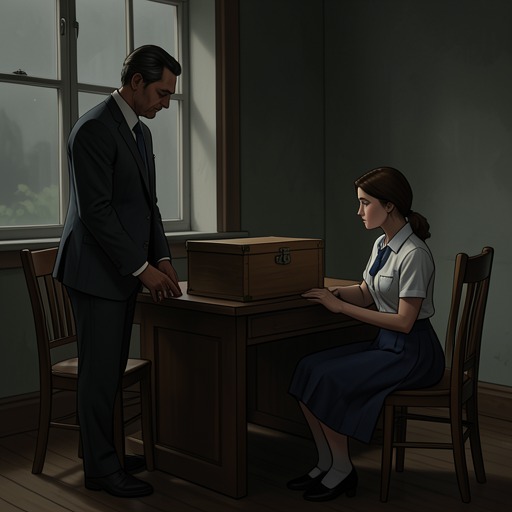
The envelope is plain, white, and unwrinkled, and bears the words “Judah and Hannah” in Mary’s handwriting. Inside is a page folded three times. Its date is May 11, 1995, the day Hannah found Mary’s body. Hannah has kept it for twenty-seven years before bringing it to her father. Judah handles the paper with extraordinary care, as if it were a sacred text, then reads its brief address and message. The care with which he unfolds it contrasts with the note’s small physical scale: one page, written in black pen, preserved for decades.
The note tells its recipients that Mary is sorry for the pain her action causes, says that “hurt and pain and tragedy” had entered their lives months earlier, and claims that her death will make things easier for them. It asks them to be strong for each other, help each other, and love each other. Its central assertion is that they already know why she had to do it. That claim gives the letter the form of an explanation, but the novel immediately tests whether it actually explains anything.
A message that does not settle the question
Judah’s reaction is not simple consolation. The note briefly brings longing and melancholy, but he soon feels irritation. He questions its brevity and its instructions to support one another, which seem to state what the family would have done regardless. He also cannot make sense of Mary’s phrase about tragedy moving into their lives, or her assertion that they know why she died. He recalls that there were treatments they had not tried, that Mary’s prospects were poor and the available treatments awful, and that he and Hannah would have helped her. Hannah had helped both parents through the terrible year, even at five years old. The note’s certainty therefore clashes with Judah’s lived memory of choices and possibilities that, to him, remained open.
Hannah does not offer a competing cause. After listening to her father’s objections, she smiles and tells him that why was never the right question. Her response does not disclose what Mary meant by saying her family knew; nor does the letter supply details that would make its claim verifiable. Instead, the exchange places the note’s confident language beside the survivors’ uncertainty. Mary’s words are preserved, but preservation does not guarantee comprehension.
The long concealment also changes the note’s role. For Hannah, who was too young to read it when Mary died, it becomes something she can carry into adulthood and finally share with her father. For Judah, its arrival reopens a question he had lived with and exposes how little its sentences can settle. He refolds the page and gives it back to Hannah rather than keeping it. The object passes between them, but the explanation does not become theirs to possess.
The note as evidence, testimony, and limit
The novel sets Mary’s recovered note against the story the narrator had once accepted about Chaim. Twelve years after Chaim’s death, the widely accepted account cast him as the Holocaust writer destroyed, at last, by what he had witnessed. Judah had never told Mary the parts of Chaim’s story that might cast doubt on suicide, and later realizes that she had steered their conversation toward Michal and the Lerners because suicide was already on her mind. In this context, a missing note could be made to support a familiar narrative, while a surviving note could appear to promise direct access to motive. The novel grants neither assumption final authority.
Chaim’s thought that a writer’s work might be a note deepens the problem rather than solving it. His writing bears witness to Auschwitz and to “Moments of Reprieve,” but it does not thereby become an explicit account of his own death. Mary’s letter speaks directly to Judah and Hannah, yet its explanation remains opaque to Judah. Together, the two cases distinguish a message from an answer: a written trace can survive, be read, and matter profoundly without making the dead fully legible. The novel’s treatment of suicide notes thus preserves the force of the questions while refusing to make either silence or a final message stand in for certainty.